What an AI analyst found in its first hour on store data

In just under an hour, DecisionBox's first run over a public e-commerce dataset linked late deliveries to lower review scores and pointed to seller handoffs as a place to act. Orders that arrived on time averaged 4.2 stars, and late ones averaged 2.5. Orders that sellers handed to the carrier after their deadline arrived late almost 4 times as often as those handed over on time.
What we ran, and on what
The data is a public e-commerce marketplace dataset: orders, items, payments, reviews, products and sellers, 8 tables in all. Nobody wrote a question for the run. DecisionBox read the tables and wrote its own playbook of areas to look at (generating a playbook is part of DecisionBox Enterprise). Then it explored on its own. It only reads the warehouse and never changes it.
The run produced 47 findings and 9 recommendations. It's the same run we use in the DecisionBox for business video series, so you can see these screens in the episodes.
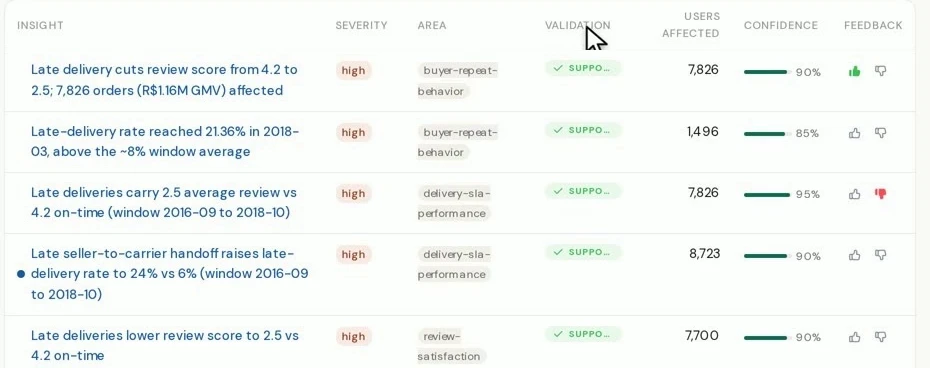
Which finding mattered most?
The run's executive summary (also an Enterprise feature) led with one story: late deliveries and low reviews go together.
- Orders that arrived after their promised date averaged 2.5 stars. On-time orders averaged 4.2.
- About 1 in 12 delivered orders arrived late.
- Among late orders, 54% got a 1 or 2 star review. Among on-time orders, 9% did.
- The late orders carried 8.8% of the value of delivered orders.
These numbers compare two groups of orders. They show where low reviews cluster. They don't measure how much a review would rise if the same order had arrived on time.
The run also looked at the listings. Products with and without photos or descriptions differed in review score by no more than 0.2 stars, against a 1.7-star gap for late delivery. That comparison comes with a condition. Some listings have an empty photo count or description, and the run asked whether that means the listing really has none or the product data simply didn't match up. If it's the second, the run can't yet tell listings with content from those without it, and the 0.2-star gap isn't measured. That needs an answer before a team decides how much attention photos and descriptions deserve.
Where does the delay start?
This is the part a team can act on. Each item in an order has a deadline for the seller to hand it to the carrier. For 111,456 items, the data holds both the deadline and the actual handoff time, and about 9% of them missed the deadline.
| Seller handoff | Orders that reached the customer late |
|---|---|
| On time | 6.24% |
| After the deadline | 24.09% |
The 111,456 counts items that have both times recorded. The percentages describe orders in each handoff group. The table doesn't estimate how many late deliveries a stricter deadline would prevent.
An order can leave the seller on time and still arrive late, as the 6.24% shows. So handoffs aren't the whole story. But they are a step the marketplace can hold sellers to, before the carrier ever has the parcel. The summary put it plainly: "The single biggest fixable lever sits upstream, with sellers, not carriers."
The run flagged two more things worth a look. In March 2018, the late-delivery rate reached 21.36%, against about 8% across the whole period. And among sellers based in one state, all 389 orders came from a single seller, and 24.42% of them arrived late. That turns a regional number into one account to talk to.
What did it recommend?
The summary closed with 3 decisions for the week:
- Hold sellers to the handoff deadline, given how much more often late handoffs end in late deliveries.
- Coach sellers on delivery reliability first, given the larger review gap for late delivery. The listing question above still needs an answer before listing quality is ruled out.
- Work with the one seller behind that state's late orders.
A finding says what the run saw. A recommendation proposes what to do about it, and how much it would help is still for the team to judge. Each recommendation links back to the findings behind it, so the person deciding can open the numbers and the queries first. Episode 4 of the series shows how to read one.
How do you know the numbers hold?
DecisionBox checked the review gap, the March spike, the late handoffs and the single-seller finding with new queries written for the check, and recorded a verdict for each. All 4 were marked Supported. The validation page explains the check, our earlier post on how DecisionBox checks a finding walks through one, and episode 1 shows a finding with its verdict and queries.
Next to the results, the run left 2 questions for a person: the listing question above, and a check on the single seller behind the state result. The answers are saved as notes and used on the next run.
What happens on the second run?
A first run is a starting point. With the Discovery Ledger switched on (Enterprise), DecisionBox records what it covered and what is still open. After this run, it listed 4 threads to pick up next. One is to find what caused the March 2018 spike: the first run found the month and the rate, and the cause is the next run's question.
Episode 9 on YouTube: the Discovery Ledger after this first run
Questions to ask your own data
You can ask the same questions of your own data:
- What is the average review score for late orders against on-time ones?
- Of the orders that arrive late, how many left the seller or the warehouse late?
- Is there one month, region or supplier where the late rate jumps?
- When a field is empty, does that mean "none" or "not recorded"?
The first three are where this run found its most useful findings. The last one is the question it asked us.
The core of DecisionBox is in the open-source Community edition. The generated playbook, the executive summary and the Discovery Ledger shown here are Enterprise features. To see what a first run finds in your own warehouse, talk to us.